Music Documentaries That Reveal the Creative Process
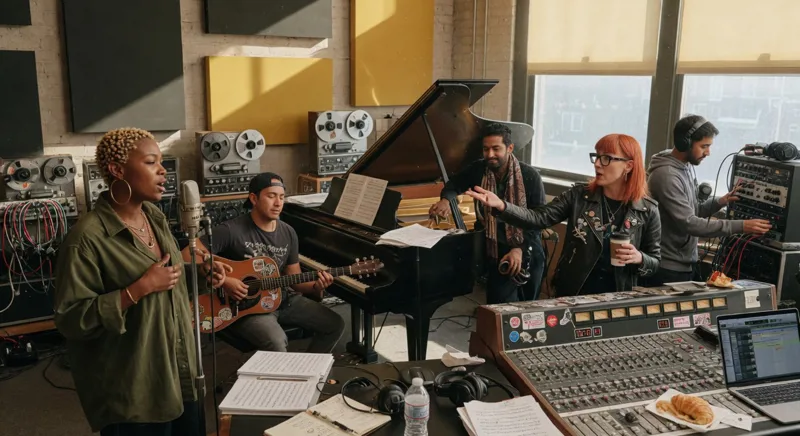
Music documentaries that reveal the creative process offer more than backstage access. They show how inspiration becomes lyrics, melodies, arrangements, recordings, and finished songs—making the mysterious work of music creation feel surprisingly human and understandable.
Why Music-Making Documentaries Are So Compelling
A polished song can sound effortless, but the path behind it is rarely simple. Artists revise lyrics, change tempos, abandon promising ideas, and negotiate creative differences before a track is complete. The best music documentaries capture those decisions as they happen.
For listeners, this creates a deeper connection with familiar music. For musicians, songwriters, producers, and music students, these films can feel like informal masterclasses in songwriting, recording, and music production.
Some documentaries focus on one album or song. Others examine a recording studio, a producer’s career, or the collaboration between artists and engineers. Together, they reveal that creativity is not just inspiration—it is also editing, experimentation, persistence, and communication.
The Best Music Documentaries That Reveal the Creative Process
Song Exploder
The Song Exploder documentary series is one of the clearest introductions to modern songwriting and music production. Each episode centers on a song and asks the artist to break it into individual elements, including vocals, drums, chords, samples, lyrics, and effects.
Its appeal comes from the detail. A musician may explain where a lyric originated, while a producer describes why a particular sound was distorted, muted, layered, or moved in the mix. Listeners hear how small decisions can transform a rough idea into a finished recording.
Songwriter
Songwriter follows Ed Sheeran as he develops songs for his album Divide. Rather than presenting songwriting as a sudden flash of genius, the film shows a working process built around melody, lyric changes, collaboration, and repeated performances.
The documentary is especially useful for anyone curious about acoustic songwriting. It demonstrates how a simple guitar progression can support different melodies and how emotional honesty often develops through multiple drafts.
Shangri-La
Shangri-La explores the Malibu recording studio associated with producer Rick Rubin. The series looks beyond equipment and celebrity, focusing on the atmosphere of a creative space and the relationship between artists, producers, and recorded sound.
It also raises an important question: What makes a recording environment productive? The answer may involve technical resources, but it can also include trust, privacy, patience, and the freedom to experiment without immediate judgment.
Quincy
Quincy offers an intimate portrait of Quincy Jones as a composer, producer, arranger, musician, and cultural figure. The documentary reveals how large-scale musical projects depend on both artistic vision and collaboration.
Viewers can observe the role of arrangement, orchestration, leadership, and musical interpretation. It is a valuable watch for anyone interested in how producers shape songs without necessarily being the most visible person in the room.
Let It Be
Let It Be provides a candid view of The Beatles developing music in the studio. The film is particularly notable because it captures musicians beginning with incomplete ideas and working toward performances through rehearsal and discussion.
That unfinished quality is its greatest lesson. Creative work often includes uncertainty, disagreement, repetition, and moments when an idea has not yet found its final form.
What These Documentaries Teach About Songwriting and Production
Although every artist has a different method, recurring stages appear across many music documentaries:
- Inspiration: A song may begin with a personal experience, phrase, rhythm, sound, image, or emotional reaction.
- Sketching: Artists record voice memos, write lyric fragments, play chord progressions, or build rough beats.
- Development: The initial idea becomes a verse, chorus, bridge, instrumental section, or complete arrangement.
- Collaboration: Co-writers, producers, musicians, and engineers challenge or expand the original concept.
- Recording: Performances are captured, selected, edited, layered, and sometimes completely reworked.
- Mixing and mastering: Balance, dynamics, spatial effects, and tonal character shape how the final track will sound.
This process explains why a demo and a finished song can feel so different. Production is not merely technical polish; it can influence the emotion, structure, pacing, and identity of the music.
How to Watch a Music Documentary More Closely
Instead of focusing only on the artist’s biography, listen for the creative choices being discussed. Ask yourself:
- What changed between the demo and the final version?
- Who introduced the central musical idea?
- How do lyrics, melody, rhythm, and instrumentation support one another?
- What does the producer remove, simplify, or emphasize?
- How do musicians respond to criticism or creative disagreement?
- Which studio sounds become part of the song’s identity?
These questions turn a documentary into a practical lesson in music appreciation, home recording, songwriting, and audio production.
Why Creative-Process Documentaries Matter
The strongest films replace the myth of effortless talent with a more useful truth: great music is often shaped through curiosity, revision, teamwork, and persistence. They show artists making mistakes, testing alternatives, and trusting the process long enough for a song to emerge.
Whether you are an aspiring songwriter, a music producer, a longtime fan, or simply curious about how albums are made, music documentaries that reveal the creative process offer a richer way to listen. After watching them, a familiar track may never sound quite the same again.
References
You May Also Like
 Entertainment
Are Streaming Bundles Actually Convenient?
 Entertainment
The Art of Building a Shared Watchlist
 Entertainment
How to Choose What to Watch When Everything Looks Good